• About
  • Visit Gray Star Design
  • Minted Collection
  • Design Services
  • Contact

The Design Inspirationalist

~ Inspiring Ideas | Spectacular Creations

The Design Inspirationalist

Tag Archives: huntington

Historic Series: David Conklin Farm House

08 Tuesday May 2012

Posted by melissaoconnor in Historic Places

≈ Leave a comment

Tags

antique, Articles of Association, David Conklin Farm House, Fort Franklin, Fort Golgotha, historic, history, huntington, Huntington Historical Society, new york, New York Avenue, Oakwood Road, The Conklin Family

My visit to the David Conklin Farm House was not only peaceful and beautiful, but a unique experience as well. Upon your arrival to this property, you can instantly feel the history. This home is a great example of how the early settlers lived and I loved how easy it was to explore. Located at 2 High Street in Huntington, this brilliant piece of architecture still exudes life, comfort and a wonderful style.

Historic Series: David Conklin Farm House - Copyright 2012 Melissa O'Connor

The Conklins were an important family when it came to the growth of Huntington as they were among its first settlers. The farm house was built in 1750 by Thomas Conklin and stood on 105 acres. It was surrounded by apple and peach orchards and took up the area from New York Avenue to Oakwood Road.

Historic Series: David Conklin Farm House - Copyright 2012 Melissa O'Connor

Historic Series: David Conklin Farm House - Copyright 2012 Melissa O'Connor

Historic Series: David Conklin Farm House - Copyright 2012 Melissa O'Connor

Member of the Conklin family were patriots and played in a big part in the town’s affairs. David and his father, Thomas, both signed the Articles of Association in 1774 and were affected by the British during the Battle of Long Island. David left for Connecticut but the rest of the family remained, leaving his wife, Sybil, alone to fend for herself. During that time, the British eventually ransacked the house.

A couple of years later, David returned only to become a prisoner of the British until 1778. While in their custody, wood was taken from the Conklin’s barn and David himself was forced to help construct Fort Franklin and Fort Golgotha. In addition, he cooked over 110 meals for the British soldiers during the time the occupied the area. I can’t imagine being in that situation. It was really tough on all of Huntington’s natives during this time. It is good to know that despite all the hardship the town was able to surpass all of it and succeed in the end.

Historic Series: David Conklin Farm House - Copyright 2012 Melissa O'Connor

Historic Series: David Conklin Farm House - Copyright 2012 Melissa O'Connor

Historic Series: David Conklin Farm House - Copyright 2012 Melissa O'Connor

Once David and his wife passed away in 1786, his nephew Abel stepped in to raise their nine children. That may seem crazy now but back then it was quite normal. Around 1827, Abel K. Conklin, Abel’s son, inherited the house after his father’s death and made a second story addition to raise his family. He later became the Town Supervisor, Justice of the Peace, Commissioner of Highways, Assessor and Commissioner of Common Schools. Abel was an important and busy member of Huntington society which eventually rubbed off on his son Moreland who served as Executive Chairman of the Committee.

By 1911, a lot of the Conklin property was sold and only 25 percent of the original land remained with the family. The Huntington Historical Society owns the deed to the house which was given to them by Ella Jayne Conklin Hurd.

Historic Series- David Conklin Farm House - Copyright 2012 Melissa O'Connor

Historic Series- David Conklin Farm House - Copyright 2012 Melissa O'Connor

Today, the home is still impressive in its ability to reflect colonial, federal and Victorian design, all of which were very popular during the period it was built. One unique piece of memorabilia that sits at the back of the house is an old mill stone which was used in one of the early mills of Huntington Harbor from 1752-1930. It was given the to Historical Society in 1951.

Historic Series: David Conklin Farm House - Copyright 2012 Melissa O'Connor

Historic Series: David Conklin Farm House - Copyright 2012 Melissa O'Connor

Historic Series- David Conklin Farm House - Copyright 2012 Melissa O'Connor

I suggest you visit the Conklin Farm House if you have a couple of hours to spare. Just the architecture and land itself are worth the trip, but if you take a tour that is an added bonus.

Historic Series- David Conklin Farm House - Copyright 2012 Melissa O'Connor

The house is open Thursday, Friday and Sunday from 1-4 p.m. and group tours can be set up as well. For more information, call (631) 427-7045, ext. 401.

Historic Series: The Henry Townsend House

25 Wednesday Apr 2012

Posted by melissaoconnor in Historic Places

≈ Leave a comment

Tags

antique, henry townsend house, historic homes, huntington, new york, scudder family, vintage, west neck, west neck road

The Henry Townsend House is a beautiful site. Built in 1830 by Henry Townsend himself, this historic home sits on an acre and a half of land. It is part of the West Neck Historic Road Historic District with many other homes and buildings from the 19th century.

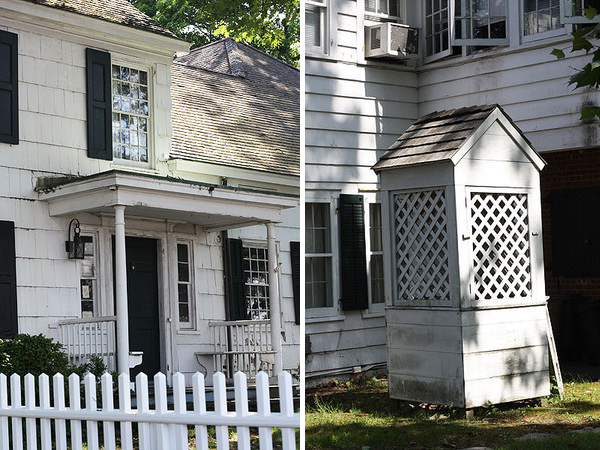
Surrounded by a picket fence the property includes a garage, smokehouse, well, shed and a privy which is an outside bathroom. You will see a lot of exterior toilets with older homes in this area. From 1858 to 1909 it was owned by the Scudder family and later the Conklins until 1911. The home was added to the National Register of Historic Places in 1985 at which W.B. Young was the owner.

Historic Series: The Henry Townsend House - Copyright 2012 Melissa O'Connor

From first glance, there is a lot to take in. The house is very elaborate in its design and has a great amount of decorative elements that really bring it to life. With one-and-a-half stories, it features a center-hall plan and a one-story side wing. This wing received exterior alterations in the 1850s such as the overhanging eaves above the porch. The glass porch in the back of the home is a much recent addition.

Historic Series: The Henry Townsend House - Copyright 2012 Melissa O'Connor

Historic Series: The Henry Townsend House - Copyright 2012 Melissa O'Connor

The front porch is held up with posts that feature scrolled corner braces. This design element is continued throughout the entire home. You will notice it significantly on the street side in the carved rafter ends of the home. This Swiss-inspired detailing creates a doll house look and adds an artistic feel to the overall design.

Historic Series: The Henry Townsend House - Copyright 2012 Melissa O'Connor

Historic Series: The Henry Townsend House - Copyright 2012 Melissa O'Connor

Historic Series: The Henry Townsend House - Copyright 2012 Melissa O'Connor

The garage was originally a carriage house built with clapboard design as well. This too has exposed rafter ends included in its one-and-a-half story plan. The six over six sash windows are also very common for this time period.

Historic Series: The Henry Townsend House - Copyright 2012 Melissa O'Connor

Because it is part of the West Neck District, the Henry Townsend House is of great significance. It expresses a love for design that you can clearly see. It’s nice to know that the current owners have kept it in such amazing shape. With the colorful flowers and lush foliage, they have brought life to the home, making this historic piece of art a modern day dream.

Historic Series: The Karpen House

06 Friday Apr 2012

Posted by melissaoconnor in Historic Places

≈ 4 Comments

Tags

antque, daniel karpen, historic homes, history, huntington, karpen house, keith hibner, lloyd harbor, long island, morris karpen, new york, vintage

I love historic areas because they hold so many memories. Huntington has so much to explore. On one of my explorations I visited the Karpen House in Lloyd Harbor. Usually, I try not to bother residents but this time I was compelled to knock on the door. When I pulled up on Harbor Hill Drive, the house seemed a little buried within the trees. In order for me to get some good photos, I had to go meet who lived inside.

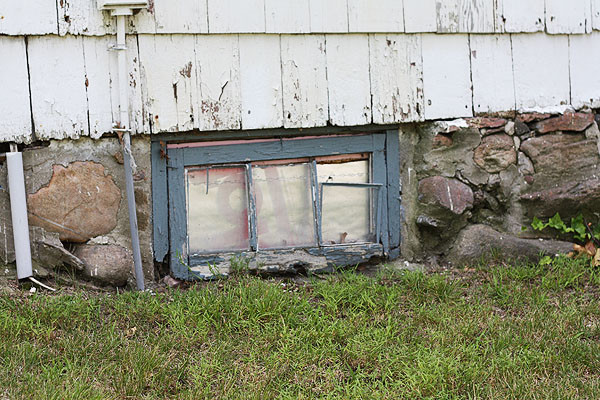
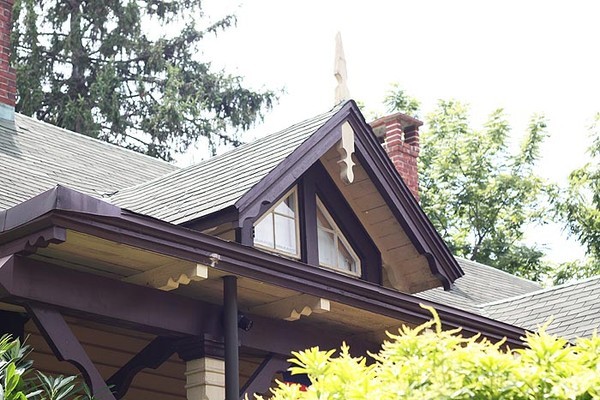
Historic Series: The Karpen House - Copyright 2012 Melissa O'Connor

Historic Series: The Karpen House - Copyright 2012 Melissa O'Connor

Daniel Karpen met me at the door and welcomed me inside to check out the house. He gave me tons of written materials so I had the information I needed. He was also nice enough to give me a tour of the interior and pointed out the historic elements of the home. I was really in awe of some of the original elements that remained and honestly, quite surprised they were in such good shape.

The kitchen was one of my favorite stops because I love vintage appliances. The blue General Electric oven and stove were awesome. The stainless steel sink was also never replaced. The small green house that was attached to the back of the kitchen was adorable. I would love to have one of those!

Historic Series: The Karpen House - Copyright 2012 Melissa O'Connor

Historic Series: The Karpen House - Copyright 2012 Melissa O'Connor

As we continued forward, I was really taken aback by some of the design choices of the architect. Since the house was built in the mid-1950s, I could appreciate the clean lines and subtle modern touches. With all the dark wood furniture and the granite fireplace, the living room held a warm and natural feeling. The original floor had been cork tile, but it was replaced with ceramic in 1961.

Historic Series: The Karpen House - Copyright 2012 Melissa O'Connor

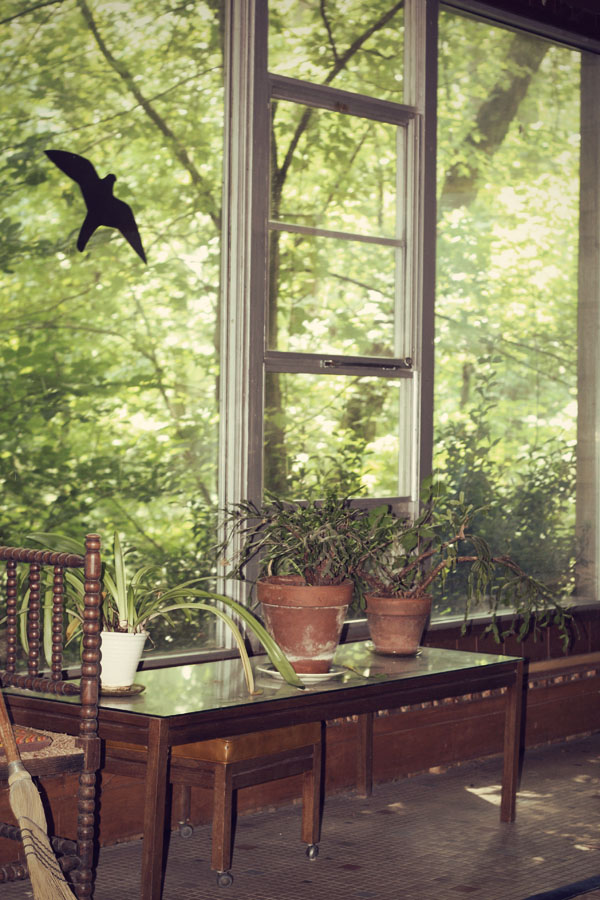
Its best feature? The windows. With an 11-foot ceiling, these huge thermopane beauties allowed nature to literally become part of the house. How awesome is that?

Historic Series: The Karpen House - Copyright 2012 Melissa O'Connor

Historic Series: The Karpen House - Copyright 2012 Melissa O'Connor

Historic Series: The Karpen House - Copyright 2012 Melissa O'Connor

Historic Series: The Karpen House - Copyright 2012 Melissa O'Connor

The closets throughout the house were original as well as the doors and room panelling. The basement was very unique in that it didn’t feel like a basement at all. Who ever heard of a basement with ten-foot ceilings? So unbelievably cool.

Karpen told me his father was claustrophobic so you can understand the need for space. The house also sits on a hill, so when you look out the windows its seems as if you are on the first floor. Because Karpen does woodwork and builds furniture, he has transformed the space into his studio. He has such a big wood collection, you wonder where he gets it all. I also enjoyed seeing his collection of vintage tools.

Historic Series: The Karpen House - Copyright 2012 Melissa O'Connor

Historic Series: The Karpen House - Copyright 2012 Melissa O'Connor

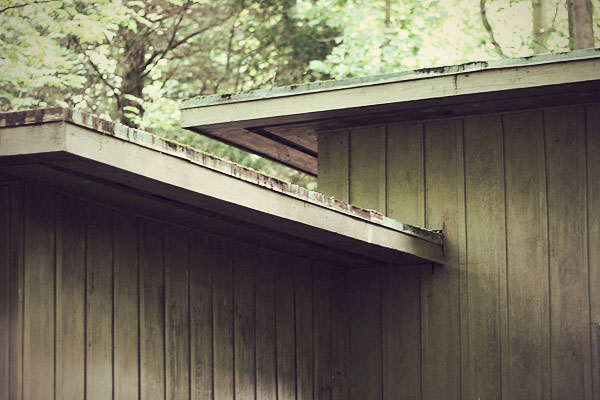
After our little tour of the inside, we walked outside to get some more photos. It was a bit tricky with all the trees but I must say it was quite beautiful. These trees are vital to the home because they give it shade which the house needs because it does not have air conditioning. Built in 1955, the international-style home in Lloyd Harbor is a long, low residence surmounted by a flat roof with overhanging eaves. The roof is also a green roof and covered in moss. Having a flat roof does have its advantages.

Historic Series: The Karpen House - Copyright 2012 Melissa O'Connor

Historic Series: The Karpen House - Copyright 2012 Melissa O'Connor

Historic Series: The Karpen House - Copyright 2012 Melissa O'Connor

Historic Series: The Karpen House - Copyright 2012 Melissa O'Connor

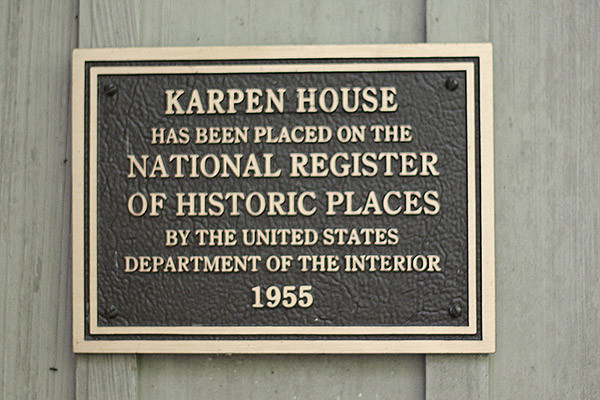
The Karpen House represents a vernacular interpretation of the Modern style and was added to the National Register of Historic Places in 2006. There also used to be a tree house in the backyard but was taken down in the 1970s due to the growth of the tree. That would have been really cool to see.

From first glance, the Karpen House might look a little disheveled but there are many treasures that lie within it. Karpen grew up here and now resides in the home which was designed by architect, Keith Hibner and built by his father, Morris. The main inspiration of the house was an Oregon home showcased in the 1951 issue of Architectural Record. It was designed by Pietro Belluschi who is a very well known architect.

Historic Series: The Karpen House - Copyright 2012 Melissa O'Connor

The Karpen family was well established and Morris was very active in politics once he moved to Huntington. He was the chairman of the Suffolk County Liberal Party as well as being a part of the capital budget committee. His main source of income was his steel plant in Farmingdale where he manufactured steel doors and frames, some of which you will see in the home itself. Once he moved to Asheville, N.C., in 1977 the plant was run by his son Seth and business partner Harold Kardeman until 1995 when it was sold. Morris passed away on March 3, 2002 and his daughter Rachel now runs the plant located in Weaverville, N.C.

You see, in all the many houses of Huntington here is one that really helped the world evolve. It housed smart individuals that really made a difference and contributed a good amount of time, effort and knowledge to their community. Not only does the Karpen House exude style and functionality, it continues to tell the story of the family who created it. The fact that it’s still standing today proves to all of us that love is the master of time and with a little TLC and memories by your side you can keep anything alive.

Historic Series – The Rogers House

20 Tuesday Mar 2012

Posted by melissaoconnor in Historic Places

≈ 1 Comment

Tags

architecture, colonial, frieze, greek revival, historic, homes, houses, huntington, new york, red, rogers house, saltbox

Historic homes have always been a love of mine. They can be found all over but I have had the chance to explore a few towns in New York for a column I used to have for Patch and I wanted to share them with my new readers. These will be part of my new Historic Series and I am very excited about it.

I have done a great deal of research for most of these homes as well as photograph them and it was fun while it lasted. The towns are Huntington, Bellmore, Wantagh and Seaford and they all have hidden gems worth seeing. Although some are not as hidden as others, they are still interesting to say the least.

I am hoping this series will inspire all of you to take a step back and appreciate the past. Sometimes history can give you a new outlook for the future. So enjoy the historic places I have explored and grab any inspiration you can. First up, The Rogers House. Enjoy!

Historic Series: The Rogers House - Copyright Melissa O'Connor 2012

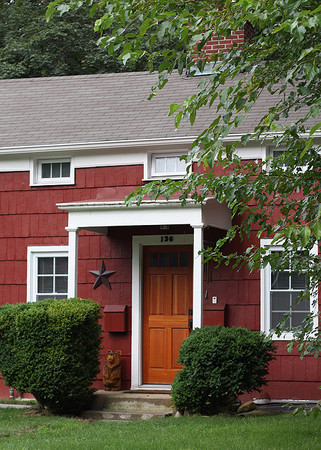
There are many historic homes in Huntington, all easily identified by their style and design. The Rogers House is one of those homes. Located at 136 Spring Road, this red-shingled home was built in 1820 and is a significant example of settlement period architecture.

Since its construction, the home has had about seven owners but the building is named after its second 1836 owner, Rogers, because the first one is not known.  Its saltbox design is composed of a five-bay, center hall plan and sits on a three-quarter acre lot.

Historic Series: The Rogers House - Copyright Melissa O'Connor 2012

The front entrance has a door with simple molded surround and a small covered porch.  There are five original three-pane windows along the top of the home (frieze) and a side entrance has a roofed porch with square columns. There is also a small shed like structure attached to the left side of the house.  The original nine-over-six double hung windows were replaced in the early twentieth century.

Historic Series: The Rogers House - Copyright Melissa O'Connor 2012

This is one of few homes that represent the five-bay center-entrance plan in Huntington that remains somewhat unaltered.  It was built as a single residence and includes numerous details of the Greek Revival style.  These would be the frieze with three-pane windows, the corner pilasters and its main entrance surround.

Most of the larger homes built in the late 19th Century have been demolished or had many alterations. The Rogers home, along with the Stewart and Funnel Houses, are surviving examples of the period that show a high level of craftsmanship, design and historical value.

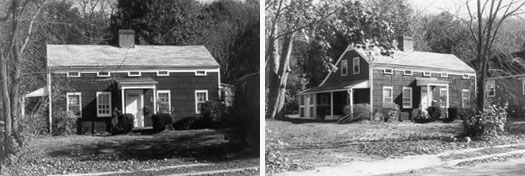
{Here is the Rogers House in 1984}
Historic Series - The Rogers House

Newer posts →
color in films sound in color art inpsired palettes
art and design the home events and parties weddings real weddings color inspiration film-reviews historic places news and updatesminted


minted.com

Enter your email address to follow this blog and receive notifications of new posts by email.

Archives


martha

Magnolia Rouge

Screen Shot 2014-04-23 at 2.29.10 PM

Etsy

Screen Shot 2014-04-23 at 2.18.10 PM

logo

Screen Shot 2014-04-23 at 2.42.13 PM

P&PBlogHeader

wedding chicks


ruffled

Screen Shot 2014-04-23 at 2.47.49 PM

Screen Shot 2014-04-23 at 2.16.32 PM


lauren-elle-photography

jenlombardo

logo_website

site-logo1

kelly_dekenipp_logo

homelogo

Website Powered by WordPress.com.

Privacy & Cookies: This site uses cookies. By continuing to use this website, you agree to their use.
To find out more, including how to control cookies, see here: Cookie Policy
  • Subscribe Subscribed
    • The Design Inspirationalist
    • Join 1,379 other subscribers
    • Already have a WordPress.com account? Log in now.
    • The Design Inspirationalist
    • Subscribe Subscribed
    • Sign up
    • Log in
    • Report this content
    • View site in Reader
    • Manage subscriptions
    • Collapse this bar
 

Loading Comments...